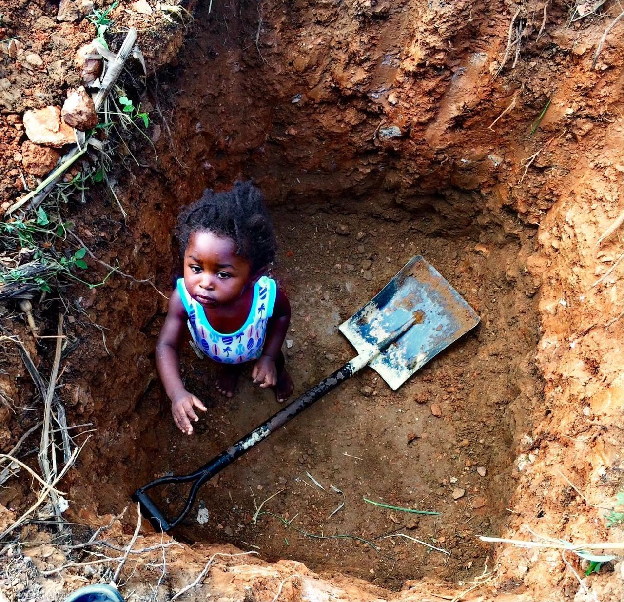
Before we go beneath the surface of an experience, we should first attend carefully to what is before us, seeking to see as clearly as possible before our assumptions, beliefs or desires tell us what we are looking at.
What happened?
What do I know?
What did I experience?
What am I assuming?
What have I interpreted?
What do I want to be true?
What might I not yet see?
This is where Truth enters the excavation.
We speak of my truth and your truth. Yet you and I can experience the same circumstance and understand it differently. Our experiences may both be real, while our interpretations of what occurred may not be the same — and neither of us may possess the whole picture.
So the question remains:
What is actually so?
There may be times when the most truthful answer available to us is simply:
I do not yet know.
That is not a failure of the excavation.
It may be where humility begins.
A Look Through Ifarounke’s LensReflections for a Deeper Seeing
What do we refer to as Reality?
Granted, the circumstance before us matters. But are the changing circumstances of everyday life the whole of Reality?
What we encounter is manifestation — real in itself, but not the entirety of what is.
We encounter what is from where we stand within it, able to perceive only what is available to us from that particular place and moment.
What manifests arises from a particular mix of conditions, choices, actions and variables. It is part of the greater whole I refer to as the IS.
There are principles and conditions at work
We know that life operates according to principles and conditions that do not depend upon our understanding of them. Gravity is an obvious example. Our bodies operate through biological processes whether or not we understand those processes.
Causes, conditions and actions produce effects, sometimes in ways we can predict and sometimes in ways we cannot.
Unlike laws created by human beings, which may be obeyed or broken, these principles and conditions are not dependent upon our compliance. We may act within them in different ways, but our actions do not suspend their operation.
We may understand some of them well, understand others only partially, and remain unaware of still others. Our ignorance of them does not necessarily prevent their operation.
This matters because consequence need not always be understood as punishment or reward. Sometimes what we encounter is natural operation: conditions, causes and consequences unfolding whether or not we understand or believe in the principles and processes at work.
The surface of what we encounter, then, is not something to dismiss. It gives us information. It is the place from which we begin.
But we do not have to mistake what first presents itself for all that there is.
We establish what we can. And then we continue the excavation.
A Look Through Ifarounke’s LensReflections for a Deeper Seeing
Unearthing Wisdom
The more I excavate, the less Wisdom appears to me as something we possess, or even as something that can be separated from the circumstances in which we engage her.
Wisdom is not acquired once. It must continually be engaged anew with what is presently so.
What is wise in one situation may not be wise in another. A statement may contain wisdom and still not apply equally to every person, circumstance or moment. The principles may remain, but the variables change.
Wisdom must therefore begin with what is actually so.
She cannot work backwards from an ideal and make the present circumstance conform to it. Nor can she work with a situation that does not exist. She must engage the Reality before us — the conditions, history, capacities, choices, limitations and possibilities presently in the field.
The Reality of the immediate situation is not the whole.
Wisdom must also hold that Reality within the larger field of the IS of which it is part. She works with the particular without mistaking the particular for the whole.
We belong within the IS. It does not belong to us.
This matters because Wisdom is not magic. She cannot alter the IS or operate outside its parameters. The Reality of a particular situation, however, is not the IS. It is a particular configuration within it — a configuration continually subject to change as conditions, choices, actions and variables shift.
Wisdom must therefore remain responsive to the Reality as it presently is.
She cannot erase what has already happened, suspend the principles and conditions at work, remove another person's agency, or guarantee an outcome where variables remain beyond our knowledge or control.
Our participation is one part of that changing configuration, alongside other influences and variables. What we choose and implement enters the mix, becoming part of the conditions from which what manifests next may arise.
Reality moves. Rigidity doesn't.
Wisdom works with what is available.
And we can only engage what is from the capacity we presently possess.
We do not come empty. What we bring may help us recognize what is before us, or impede our ability to see it. Wise engagement therefore requires fair play — enough openness to allow what is before us to be what it is, rather than requiring it to confirm what we already believe, desire or expect.
We can only see as clearly as our present vision allows.
And so Clarity is important, but Clarity alone is not Wisdom.
A clever person can see clearly. A strategist can understand the variables in a situation and use that understanding to achieve a chosen objective. A manipulator may read people exceptionally well.
Wisdom seems to require something more.
I am beginning to see Wisdom as functioning like a tuning fork. A tuning fork provides a stable reference note against which an instrument can be tuned. It does not change its note to accommodate the instrument, nor does it determine the music that will be played.
The musician listens to the reference note, listens to the instrument, notices the difference and makes an adjustment. Then she listens again. The reference remains stable; it is the instrument that is being brought into tune.
But the tuning fork cannot determine how accurately its note is heard.
The musician brings her own capacity to listen and distinguish one sound from another. She may hear accurately. She may hear imperfectly. She may even believe she is in tune when she is not. The reliability of the reference does not guarantee the accuracy of her perception.
I am beginning to think Wisdom operates in much the same way.
The Reality before us changes. Our understanding, choices and responses may need to change with it. Wisdom does not make those choices for us. Rather, it offers a reference against which we can continually examine and adjust our participation within the wider IS.
Our capacity matters here too. We can only work with what we are presently able to perceive and understand. Our limitations do not alter the reference, but they may affect what we make of it.
The reference does not tell us what to want or what to choose. It asks us to consider our choices in relation to more than our immediate objective.
What we want matters, but it is not all that matters.
We may know this and still choose what we want. Wisdom does not remove choice. We may recognize other considerations, understand something of the consequences, and decide that our immediate objective matters more to us.
The reference has not failed. We have chosen what to do with what we heard.
Nor does attending to the wider field necessarily mean sacrificing ourselves to some idea of the greater good. We, too, belong within that field. Our wellbeing, needs and desires are among the things that matter.
The question is not whether we erase ourselves for the whole, but whether we erase the whole in service of ourselves.
This is also why Wisdom need not prescribe the same course for everyone. Two people may desire the same destination and require very different ways of reaching it. Their capacities, resources, discipline, histories, responsibilities and circumstances may differ.
Despite the old saying, what is good for the goose may not always be good for the gander.
A response that was wise yesterday may cease to be wise when the field changes. A principle may remain sound while its application changes. New information may emerge. A previously unseen variable may become visible. Our own capacity may grow.
Yesterday's rain cannot wet today's fields.
Perhaps this is part of her invitation to excavation.
Something presents itself: a contradiction, a consequence, a recurring pattern, an unexpected result, a question we cannot answer. What presents itself may not give us the answer. It gives us something to examine.
Wisdom can invite the excavation.
She cannot excavate for us.
We must look. We must remain long enough to discern what we can. We must be willing to discover that what we previously believed no longer adequately explains what is before us.
We cannot know before we know. And even when we think we know, what we know is shaped by what is available to us, where we stand, and our present capacity to perceive and understand it.
Sometimes, then, the clearest finding available to us will be:
I do not know.
There is no shame in that. Hubris impedes Wisdom because it mistakes the limits of our present understanding for the limits of what there is to understand. It stops excavating and starts proving.
We bring out the hammer instead of the brush.
Wisdom does not choose for us.
Choice remains ours.
Our beliefs, values, intentions, desires and orientation help determine what we choose to do with what has been unearthed.
But choice is not implementation.
Wisdom does not implement for us. We do.
What we actually do enters the mix. Our action becomes part of the conditions from which something further may manifest. Consequences emerge. Other people choose. Conditions change. Something we could not previously see may become visible.
And the Reality before us is no longer exactly what it was.
So we look again.
Perhaps this is why Wisdom is a lifelong dance.
We engage from where we presently stand and with the capacity we presently possess. The engagement may reveal something. What is revealed may enlarge our capacity. Greater capacity may allow us to recognize something we could not have recognized before.
Sometimes we could not have arrived where we are without first having been where we were.
Recognizing the limits of our former capacity does not remove responsibility for our choices. But responsibility need not become blame or shame. We cannot require our former selves to have known what they did not know, or to have seen with a capacity they did not yet possess. What matters is whether, when something further becomes available to be seen, we are willing to look again.
Perhaps, then, Wisdom is not a possession, a fixed prescription or a collection of answers.
She invites us to engage with the Reality that is actually here, without mistaking it for the greater whole to which we belong.
Sometimes there is more to see than what we came looking for.
And the dance continues.
A Look Through Ifarounke’s LensReflections for a Deeper Seeing
The excavator comes to the dig
There is another difficulty.
None of us arrives at an excavation empty-handed.
We bring our histories, beliefs, knowledge, culture, desires, wounds, fears, expectations, experiences and assumptions with us.
Preconceived notions can be particularly dangerous to any dig. If I arrive already certain of what I am going to find, I may spend the entire excavation confirming what I brought rather than discovering what was there.
So part of the work is not merely examining the site.
We must also examine the excavator.
What am I expecting to find?
What do I hope is true?
What would I prefer not to discover?
What have I already decided this experience means?
What belief am I protecting?
What am I bringing to what I see?
The challenge is not to pretend that we bring nothing with us.
It is to become sufficiently aware of what we bring that:
we do not mistake what we brought for what we unearthed.
A Look Through Ifarounke’s LensReflections for a Deeper Seeing
Dig deeply. Handle gently.
How we conduct the excavation matters.
Blame and shame — and their cohorts — are poor excavation tools.
Removing them does not mean removing responsibility, accountability, consequence or choice. We can acknowledge harm without turning shame into identity. We can accept responsibility without making condemnation the instrument through which understanding must come.
And we need a soft touch.
There is no place here for a bull-in-a-china-shop approach to truth.
We cannot smash our way through ourselves or one another in pursuit of understanding and then dismiss what we have broken because our intentions were good.
Intention does not justify means.
If the intention is healing but the means unnecessarily wound, the wound is still part of what has been created.
If the intention is truth but the means are cruel, the cruelty still occurred.
If the intention is understanding but the manner of our inquiry destroys trust, the destruction of trust matters.
Some things are fragile.
Some things reveal themselves slowly.
Some things must be held before they can be understood.
Gentleness does not mean weakness. There are times when Wisdom may require firmness, boundaries, difficult truths and decisive action.
But firmness need not become brutality.
So I return to a simple ethic:
Dig deeply. Handle gently.
A Look Through Ifarounke’s LensReflections for a Deeper Seeing
Following the vein
I have also begun to think of this relationship with Wisdom as something like following a vein toward gold.
Finding the vein is not the same as possessing the whole deposit.
What we uncover gives us information about where to look next.
And the vein may turn.
If it turns and I insist on continuing straight because that is the direction in which I began, my consistency has not kept me aligned.
I have lost the vein.
This is why alignment cannot mean immobility.
Alignment is not stubbornly continuing in the same direction.
Alignment is remaining with the vein.
New information may require movement. Experience may reveal something we could not previously see. What we thought we knew may have to be reconsidered.
Changing course under those circumstances is not vacillation.
Recalibration is course correction.
We do not abandon the orientation.
We adjust our movement in order to remain faithful to it.
A Look Through Ifarounke’s LensReflections for a Deeper Seeing
The dance
Life moves.
Circumstances change. Information emerges. Experience teaches. Our understanding deepens, falters, surprises us and sometimes asks us to reconsider what we thought we knew.
Wisdom does not require us to stand still.
Perhaps she asks us to become more attentive participants in a dance that is already taking place.
Because attentive or not, we are already in the dance.
Our actions, inactions, choices — and even our refusal to choose — enter the movement and become part of what unfolds.
Attention matters. It helps us recognize our participation and the agency available to us within the dance.
If our attention is elsewhere, we may fail to notice the movement we are already part of.
We may not always recognize how we are participating. We may find ourselves being carried by the movement without realizing it. At other times, we may knowingly allow ourselves to be carried.
Awareness does not mean that we fully understand where the movement may lead or all that it contains.
Whether we lead, follow, resist, or simply allow ourselves to be carried by the movement, we are participating nonetheless.
Sometimes we move beautifully.
Sometimes we lose the rhythm.
Sometimes we step on toes.
Sometimes we realize we have been dancing to something that was never ours.
And sometimes the most important movement is the willingness to stop, listen, locate the rhythm again and continue.
There need be no shame in course correction.
But there must be willingness to remain in sync with the dance.
A Look Through Ifarounke’s LensReflections for a Deeper Seeing
What has begun to emerge
As I continue to excavate, certain relationships have begun to reveal themselves to me:
Realityis what is presently so.
Truthasks, What is actually so?
Humilityacknowledges the limits of our perception.
Wisdomis the ongoing practice of calibrating our engagement with the Reality before us, while remaining faithful to the recognition that the present Reality is not the whole of what is.
Experiencesupplies information.
Reflectionhelps us examine it.
Attentionhelps us notice what is changing — and what we may have missed.
Self-accountabilitykeeps us willing to examine and own what the process reveals about ourselves and our part in what unfolds, and to respond when what we see calls for adaptation or change.
Growthis the development of the capacity with which we participate, shaped by what we gain, refine and sometimes relinquish along the way.
Choiceremains ours.
Implementationis ours too.
Alignmentkeeps us oriented without requiring immobility.
Recalibrationallows us to adjust our movement without abandoning the orientation.
The dancecontinues.
I do not offer these as commandments or final answers.
They are things I have begun to notice along the dig.
And tomorrow's excavation must be allowed to reveal more.
That is part of the stance itself.
I can stand somewhere and still be willing to look again.
A Look Through Ifarounke’s LensReflections for a Deeper Seeing
You may enter wherever you are
People come to Wisdom for different reasons.
Some arrive because something hurts.
Some because something no longer makes sense.
Some are curious.
Some are searching.
Some are creating.
Some are questioning what they have been taught.
Some simply encounter an image, a sentence, a card, a book or a conversation that causes them to pause.
There is no requirement that we all enter at the same depth or through the same door.
You may stay at the surface for a while.
You may pick up one thing and carry it with you.
You may draw a reflection for the day and leave.
Or something may catch your attention and make you wonder:
What else is here?
Then perhaps you dig.
My books, reflections, cards, conversations, imagery, videos and other creative work have emerged from my own continuing exploration. They take different forms because Wisdom does not meet me in only one place or speak through only one medium.
This website brings those expressions together.
You can enter through whichever portal calls your attention.
I will not be standing on the other side pretending that I have arrived.
I am in the excavation too.
Perhaps we will notice different things.
Perhaps something you encounter here will confirm what you already know.
Perhaps it will disturb an assumption.
Perhaps it will raise a question for which neither of us presently has an answer.
Perhaps it will simply invite you to look again.
That is enough.
Because Wisdom is not something I can hand you as a completed explanation.
It is something we practice in our continuing engagement with the Reality before us.
So we pay attention.
We question.
We listen.
We examine our input.
We follow the vein.
We correct course when necessary.
We dig deeply and handle gently.
And we remain open to what has not yet been unearthed.
The dance continues.
A Look Through Ifarounke’s LensReflections for a Deeper Seeing
 A Look Through Ifarounke’s Lens
Reflections for a Deeper Seeing